5 RELATIONSHIP
Why Do We Need Relationships?
- All systems encompass many classes and objects
- Objects contribute to the behavior of a system by collaborating with one another
- Collaboration is accomplished through relationships

In object-oriented modeling, there are three kinds of relationships that are most important: dependencies, generalizations, and associations.
- Dependencies are using relationships. For example, pipes depend on the water heater to heat the water they carry.
- Associations are structural relationships among instances. For example, rooms consist of walls and other things.
- Generalizations connect generalized classes to more-specialized ones in what is known as subclass/superclass or child/parent relationships. For example, a picture window is a kind of window with very large, fixed panes.
5.1 Generalization
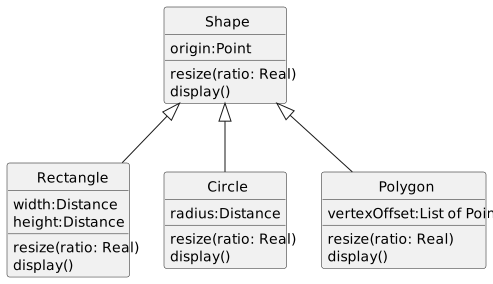
- A generalization is a relationship between a general kind of thing (called the superclass or parent) and a more specific kind of thing (called the subclass or child).
- Generalization is sometimes called an “is-a-kind-of” relationship: one thing (like the class
BayWindow) is-a-kind-of a more general thing (for example, the classWindow)
// TO DO5.2 Association
An association is a structural connection between classes \(\to\) This implies that there is a link between objects in the associated classes
Associations are represented on class diagrams by a (solid) line connecting the associated classes
Navigation across an association can be
- bidirectional (default)
- uni-directional
Name: An association can have a name, and you use that name to describe the nature of the relationship.
Role: When a class participates in an association, it has a specific role that it plays in that relationship.
Multiplicity: In many modeling situations, it’s important for you to state how many objects may be connected across an instance of an association.
Consider the association of member
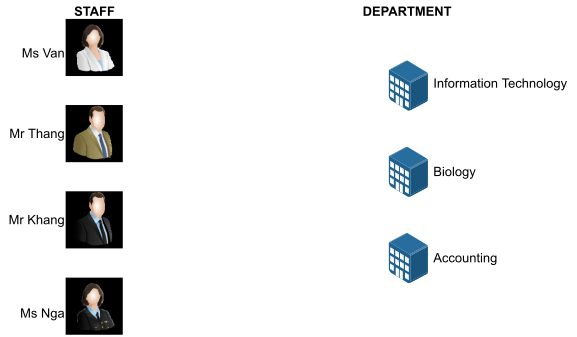
- Association relationship between class A and class B
- there is at least one attribute of class B in class A and/or
- there is at least one attribute of class A in class B

// TO DOAggregation
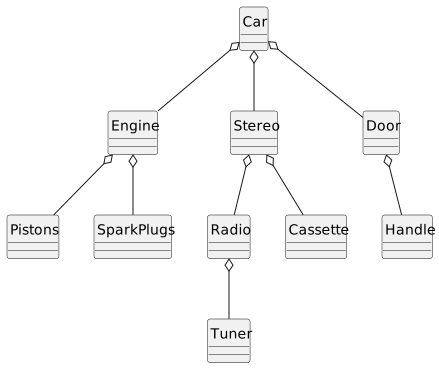
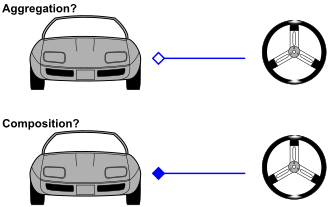
- Aggregation is a specialized form of association in which a whole is related to its part(s)
- Aggregation is known as a “part-of” or containment relationship
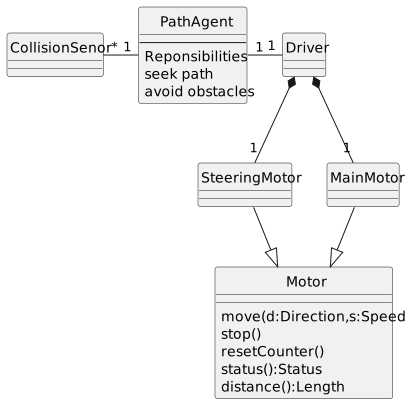
- An aggregation is represented as an association with a diamond next to the class denoting the aggregate (whole)

// TO DOAssociation or Aggregation?
- If two objects are tightly bound by a whole-part relationship \(\to\) The relationship is an aggregation
- If two objects are usually considered as independent, even though they are often linked \(\to\) The relationship is an association

// TO DO- An aggregation hierarchy for a car.
// TO DO- Associations as a separate service.

Reflexive Associations
- In a reflexive association, objects in the same class are related
- Indicates that multiple objects in the same class collaborate together in some way
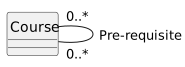
// TO DOReflexive Aggregates
- Aggregates can also be reflexive
- Classic bill of materials type problem \(\to\)This indicates a recursive relationship

// TO DOComposition
- A form of aggregation with strong ownership and coincident lifetimes
- The parts cannot survive the whole/aggregate
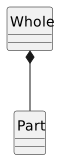
// TO DOAggregation or Composition?
5.3 Dependency
- A dependency is a relationship that states that one thing (for example, class
FilmClip) uses the information and services of another thing (for example, classChannel), but not necessarily the reverse.
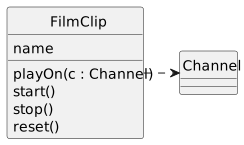
Dependencies vs. Associations
- Associations are structural relationships
- Dependencies are non-structural relationships
- In order for objects to “know each other” they must be visible
- Local variable reference
- Parameter reference
- Global reference
- Field reference
Permanent relationships — Association (field visibility)
- Relationships are context-dependent
Transient relationships — Dependency
- A context-independent relationship
- Multiple objects share the same instance
- Pass instance as a parameter (parameter visibility)
- Make instance a managed global (global visibility)
- Multiple objects don’t share the same instance (local visibility)
How long does it take to create/destroy?
- Expensive? Use field, parameter, or global visibility
- Strive for the lightest relationships possible
5.4 Common Modeling Techniques
Modeling Simple Dependencies
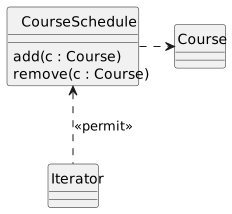
- A common kind of dependency relationship is the connection between a class that uses another class as a parameter to an operation.
- To model this using relationship,
- Create a dependency pointing from the class with the operation to the class used as a parameter in the operation.
Modeling Inheritance
To model inheritance relationships:
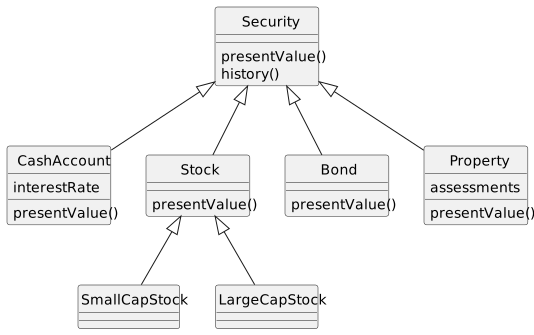
- Given a set of classes, look for responsibilities, attributes, and operations that are common to two or more classes.
- Elevate these common responsibilities, attributes, and operations to a more general class. If necessary, create a new class to which you can assign these elements (but be careful about introducing too many levels).
- Specify that the more-specific classes inherit from the more-general class by placing a generalization relationship that is drawn from each specialized class to its more-general parent.
Modeling Structural Relationships
To model structural relationships:
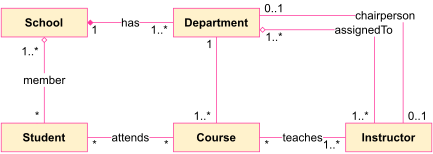
For each pair of classes, if you need to navigate from objects of one to objects of another, specify an association between the two. This is a data-driven view of associations.
For each pair of classes, if objects of one class need to interact with objects of the other class other than as local variables in a procedure or parameters to an operation, specify an association between the two. This is more of a behavior-driven view of associations.
For each of these associations, specify a multiplicity (especially when the multiplicity is not
*, which is the default), as well as role names (especially if they help to explain the model).If one of the classes in an association is structurally or organizationally a whole compared with the classes at the other end that look like parts, mark this as an aggregation by adorning the association at the end near the whole with a diamond.
Structural relationships of a set of classes drawn from an information system for a school.
Modeling Simple Collaborations
- OO Principle: Every operation is the responsibility of a single class.
- However, no class stands alone. Each works in collaboration with others to carry out some semantics greater than each individual.
To model a collaboration:
- Identify the mechanism you’d like to model. A mechanism represents some function or behavior of the part of the system you are modeling that results from the interaction of a society of classes, interfaces, and other things.
- For each mechanism, identify the classes, interfaces, and other collaborations that participate in this collaboration. Identify the relationships among these things as well.
- Use scenarios to walk through these things. Along the way, you’ll discover parts of your model that were missing and parts that were just plain semantically wrong.
- Be sure to populate these elements with their contents. For classes, start with getting a good balance of responsibilities. Then, over time, turn these into concrete attributes and operations.
Example